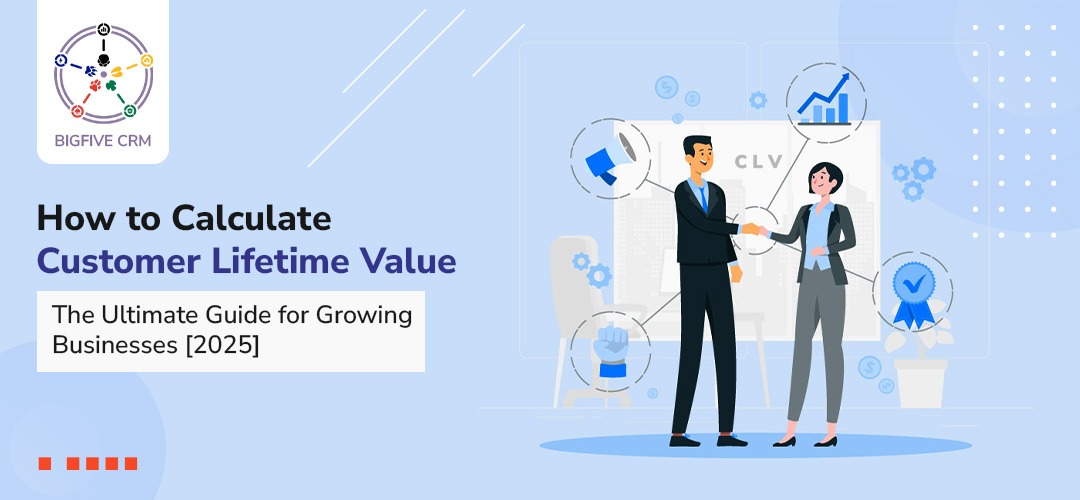
Customer lifetime value (CLV) is a vital metric for understanding sustainable business growth. This guide will discuss all elements of calculating and optimizing CLV to push your business forward.
Find out how modern CRM solutions can help companies and transform the way you track customer value, enabling data-driven decisions that affect your bottom line.
What is Customer Lifetime Value and Why Does It Matter?
Customer Lifetime Value is the total revenue a business expects from one customer account during the entire duration of their relationship. It’s like looking into the future of your customer relationships not just what they are worth today but how much they could be worth over time.
Consider this: Acquiring new customers costs five times more than keeping an existing one. With this knowledge about CLV, you can:
- Make better choices on how much to spend to gain new customers.
- Identify your most valuable customer segments
- Use resources wisely and effectively
- Create special plans for keeping customers
The Essential CLV Formula: Breaking Down the Numbers
The basic formula for calculating Customer Lifetime Value is:
CLV = Average Purchase Value × Average Purchase Frequency × Average Customer Lifespan
Let us clarify with an example from real life:
You own a software company that works on subscriptions.
- Average monthly subscription: $50
- The average time someone remains subscribed is 24 months.
- Average extra services bought per year: $200
Your calculation for CLV would be: ($50 times 24) plus ($200 times 2), which equals $1,600.
However, for more accurate results, you should also factor in:
- Customer acquisition costs (CAC)
- Operating costs
- Discount rates
- Customer service expenses
Advanced CLV Calculations: Understanding Historical and Predictive Methods
Historical CLV Method: Looking at Past Performance
The Historical CLV Method uses real-life data to compute historical lifetime value. This method gives insight based on actual buying behavior and customer interactions. Below is a more detailed explanation of how this works:
1.Data Collection and Analysis
- Collect all historical purchase data per customer
- Including transaction amounts, dates, and frequency of the transaction.
- All customer service interactions should be recorded
- Track product returns and complaints
- Document loyalty program participation
2. Cost Calculation
- Calculate total customer acquisition costs
- Include marketing expenses allocated per customer
- Factor in customer service costs
- Account for product or service delivery expenses
- Consider overhead per-customer basis.
3. Revenue Analysis
- Sum all purchases and recurring revenue
- Add up all purchases plus any recurring revenue
- Include upsells and cross-sells
- Calculate average order value
- Determine how frequently customers buy
- Look at seasonal buying trends
4. Profitability Assessment
- Use relevant profit margins
- Subtract all associated costs
- Consider discount rates
- Account for inflation
- Calculate net present value (NPV)
Predictive CLV Method: Forecasting Future Value
The Predictive CLV Method uses advanced analytics and machine learning to predict future customer behavior and value. This forward-looking approach allows businesses to proactively manage their relationships with customers.
1. Behavioral Analysis
- Study customer engagement patterns
- Analyze website interaction data
- Track email response rates
- Monitor social media engagement
- Evaluate customer feedback and surveys
2. Predictive Modeling
- Use regression analysis for purchase predictions
- Use machine learning algorithms
- Consider market trends and seasonality
- Factor in industry growth rates
- Include competitive analysis data
3. Risk Assessment
- Calculate churn probability
- Identify potential upsell opportunities
- Evaluate market conditions
- Consider economic factors
- Assess competitive threats
4. Value Projection
- Create multiple scenario forecasts
- Use probability-weighted outcomes
- Consider customer segment variations
- Account for product lifecycle stages
- Factor in market evolution
Comprehensive Strategies to Enhance Customer Lifetime Value
1. improved Customer Experience and Personalization
Create a seamless customer journey that encourages long-term loyalty:
- Implement AI-driven personalization across all touchpoints
- Develop custom communication strategies for different segments
- Generate personalized product recommendations based on purchase history
- Design targeted content marketing campaigns
- Offer customized loyalty programs based on customer behavior
2. Strategic Upselling and Cross-selling
Maximize revenue through strategic product recommendations:
- Analyze purchase patterns to determine the best timing for upsell
- Create bundles of complementary products
- Develop value-added service packages
- Implement predictive analytics for product recommendations
- Design tiered pricing strategies
3. Proactive Customer Success Programs
Establish a robust framework for customer success:
- Set up dedicated teams for customer success
- Create onboarding programs tailored to new customers
- Develop schedules for regular check-ins
- Provide training and education on the product
- Offer premium support options to customers
4. Data-Driven Retention Strategies
Use data analytics in preventing churn and strengthening relationships:
- Set up early warning systems to identify at-risk customers
- Create automated re-engagement campaigns for customers
- Develop win-back programs for dormant accounts
- Design loyalty rewards based on customer behavior
- Build referral programs for targeting existing customers
5. Value-Added Services
Enhance your core offering with additional benefits:
- Create premium support tiers
- Offer exclusive access to new features
- Develop educational resources
- Provide consulting services
- Host customer events and webinars
6. Customer Feedback Integration
Build a continuous improvement cycle:
- Establish regular feedback collection methods
- Create customer advisory boards
- Implement suggestion tracking systems
- Develop rapid response protocols
- Share product roadmaps with customers
Conclusion: Transform Your Business with CLV Insights
Understanding and optimizing customer lifetime value is essential for sustainable business growth. With the right CRM solution, you can turn CLV insights into actionable CRM strategies that drive revenue and build lasting customer relationships.
Big Five CRM offers powerful tools to help you implement both historical and predictive CLV tracking, along with comprehensive features to support all your customer value optimization strategies. Our no-code solution makes it easy to get started, with features designed specifically for growing businesses.
Ready to maximize your customer lifetime value?
Start your free trial with Big Five CRM today and access our complete suite of CLV optimization tools. Also get help from CRM integrations services from a reputed agency to get most out of it.